JACK in Tensioned Lines
This document provides supplemental information to the Instructions for Use for each piece of PPE used. It is essenftial to read and thoroughly understand these instructions first.
You may only perform these techniques safely if you have been properly trained or are under the constant supervision of a competent, trained person.
INTRODUCTION
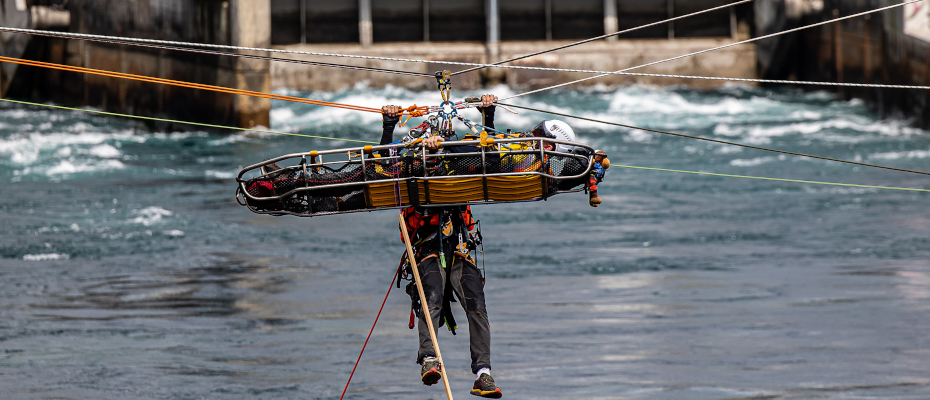
Tensioned lines (also known as Tyroleans, highlines, zip-lines, telphers, or tramways) consist of ropes rigged between two anchors to facilitate horizontal or diagonal movement, or to access areas where no other anchors or access methods are available. In rope access, they are commonly utilized for bridge inspections, overhead work, and similar tasks.
Currently, no specific standard addresses the industrial use of tensioned lines in rope access. Tensioned lines differ from a lifeline covered by the EN 795/C standard. IRATA International has released Annex T: Tensioned Lines Guidance as part of the IRATA International Code of Practice (ICOP), which now provides a framework for safe use and risk management of tensioned lines in industrial rope access.
While most rope access devices—including descenders—do not explicitly list tensioned line use in their Instructions for Use, some may be effective for tensioning and controlled release. In accordance with the aforementioned IRATA guidance, we have tested and summarized the performance, characteristics, and safety considerations for the JACK descender when used for these applications.
Theory and primary hazards
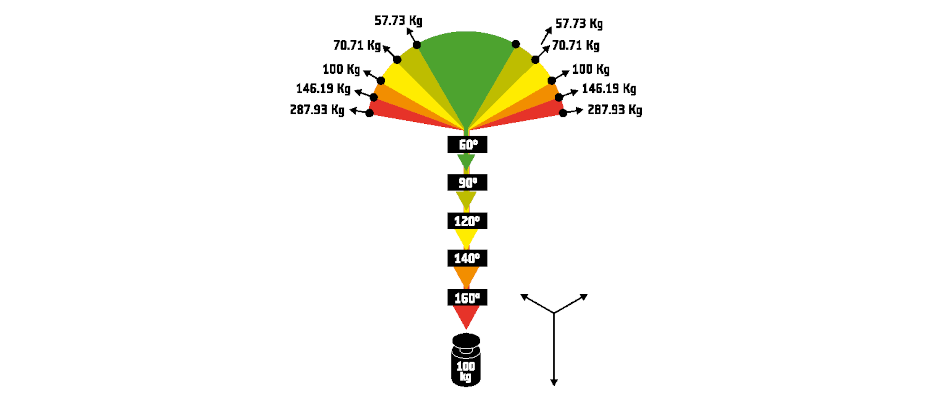
Due to load distribution, the primary hazard is system overloading, which can lead to anchor or equipment failure. Other risks include: excessive sag resulting in ground contact; rope slippage or sheath failure (leading to increased sag and potential ground contact); and the inability to release the descender while under tension. The illustration below demonstrates the relationship between loading angles and the resultant forces on the anchors.
 Pulley Efficiency Test
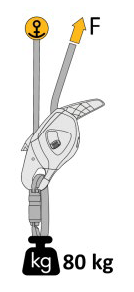
In tensioned lines, a descender is used as a low-efficiency locking pulley. As a result, there is often a significant discrepancy between the theoretical and actual efficiency of the pulley system. This test measured the force required to lift an 80 kg mass from the ground. The measurements were conducted using a new JACK descender and new ropes.
1. SETUP (1:1)
| rope | F (kg) |
|---|---|
| TENDON STATIC 10 | 239 |
| SR STATIC 10.5 | 249 |
| SR STATIC 11 | 260 |
2. SETUP (2:1)
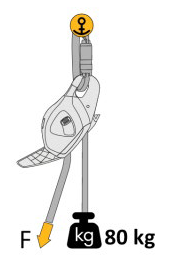
| rope | F (kg) |
|---|---|
| TENDON STATIC 10 | 63 |
| SR STATIC 10.5 | 64 |
| SR STATIC 11 | 66 |
Rope Slippage Test
This test measured rope slippage through the JACK descender. The values below represent the load (kN) at which a brand-new rope typically begins to slip during slow-pull laboratory testing. For comparison, both a brand-new device and a partially worn unit were tested.
| Rope Type and Diameter (mm) | New JACK (kN) | Worn JACK (kN) |
|---|---|---|
| TENDON STATIC 10 | 5.8 | 3.3 |
| SR STATIC 10.5 | 5.8 | 3.7 |
| SR CONTRA 10.5 | 5.8 | 3.5 |
| SR STATIC R44 10.5 | 6.0 | 3.7 |
| SR STATIC 11 | 11.0* | 6.3 |
| SR CONTRA 11 | 8.1 | 5.1 |
| SR STATIC R44 11 | 7.4 | 5.0 |
| SR STORM 9.8 | 3.5 | 0-2 |
*) outer sheath of the rope was damaged
Using a worn JACK descender with certain rope types may lead to slippage within the tensioned line, resulting in increased sag.
Tensioning and Release Test
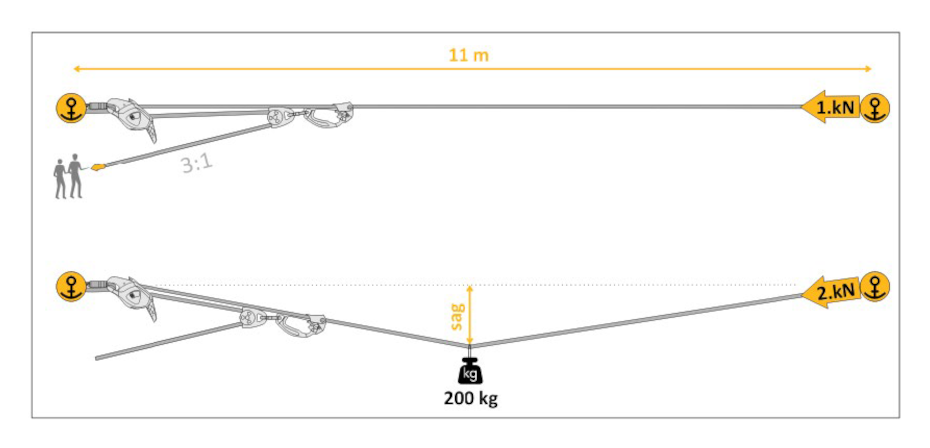
The load exerted on anchors and equipment, as well as the resulting sag, are primarily affected by the length of the tensioned line, the initial tensioning force, and the additional load applied to the line. In this test, an 11-meter horizontal line was tensioned, loaded, and measured according to the following procedure:
- Initial Tensioning: Tensioning a single 11 m horizontal line and measuring the resultant force on the anchor.
- Loading: Applying a 200 kg load to the center of the line, then measuring the anchor tension and the total sag.
- Controlled Release: Releasing the tensioned line using the JACK descender.
- Repetition: Repeating the procedure with increased levels of initial tension.
Rope used: SINGING ROCK STATIC 11.0 rope clamp used: LIFT ascender
| Tensioning Method | Initial Tension (kN) | Tension w/ 200 kg (kN) | Sag (cm) | Rope Slippage (cm) | JACK Release |
|---|---|---|---|---|---|
| 3:1 – 1 person easy pull | 1.0 | 3.2 | 190 | 0 | Easy |
| 3:1 – 2 persons easy pull | 2.0 | 4.0 | 180 | 0 | OK |
| 3:1 – 2 persons hard pull | 3.0 | 4.55 | 145 | 0 | OK |
| 5:1 – 2 persons easy pull | 4.0 | 5.55 | 120 | 0 | Hard but possible |
Tests indicate that initial tension is a primary factor influencing the final anchor load. While higher initial tension partially reduces sag, it significantly increases the forces exerted on the anchors.
During the test, the JACK descender was released without additional friction and without any problems. Nevertheless, we recommend using a pulley system for a controlled release, especially when releasing tensioned lines under human load (tensioned line rescue).
Use a 3:1 pulley system pulled by no more than two people generates sufficient initial tension and is recommended for most scenarios. Increasing the mechanical advantage or involving additional personnel for tensioning should be avoided to prevent overloading.
Additional tips
Sag ( m ) = Length ( m ) x Load ( kg ) / 1000
(Example: A 10 m span under a 100 kg load generates approximately 1 m of sag)
If you have any questions, feel free to contact us at info@singingrock.cz.